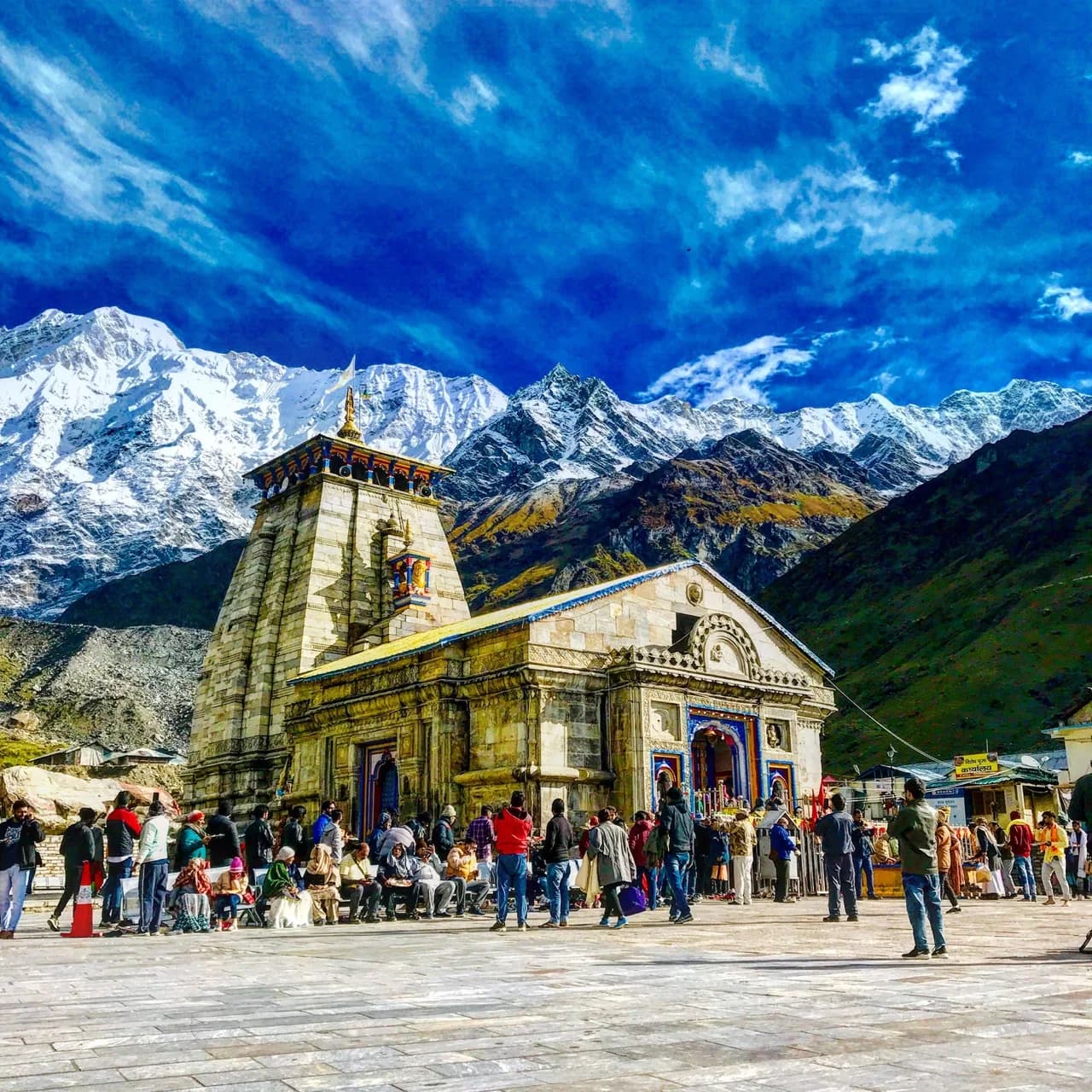
About Badrinath Dham
Badrinath is one of the four sacred Char Dhams established by Adi Shankaracharya and the most important of the Panch Badri shrines. Dedicated to Lord Vishnu in his Badrinarayan form, the temple sits at 3,133 metres on the banks of the Alaknanda river, flanked by the Nar-Narayan mountain peaks and facing the snow-covered Neelkanth peak (6,596m).
Unlike Kedarnath, which requires a trek, Badrinath is accessible by road — the motorable highway reaches within a few hundred metres of the temple, making it accessible for all pilgrims regardless of physical fitness.
Badrinath 2026 Opening Date
Badrinath Dham typically opens 2–3 days after Kedarnath, usually in early May. For 2026, the opening is expected around 4–6 May 2026. The exact date is announced at Basant Panchami (late January) after the Jyotish calculation by the Rawal (head priest).
The temple closes in November (usually first or second week) before winter snowfall closes the Badrinath highway. Both opening and closing ceremonies involve elaborate rituals.
How to Reach Badrinath from Haridwar
Distance: 318 km by road | Travel time: 10–11 hours (if done in one stretch, which is not recommended).
- Haridwar → Rishikesh: 24 km | 45 min
- Rishikesh → Devprayag → Rudraprayag: 145 km | ~4 hrs. National Highway 58 (also called the Badrinath National Highway).
- Rudraprayag → Chamoli → Joshimath: 100 km | ~3 hrs. Chamoli is the district headquarters.
- Joshimath → Badrinath: 49 km | ~1.5 hrs. Spectacular drive past Vishnuprayag confluence and Pandukeshwar.
Recommended plan: Break the journey with an overnight stay at Joshimath (or Pipalkoti). Arrive Badrinath fresh for early morning darshan.
Badrinath Temple — Darshan Timings 2026
- Maha Abhishek: 4:30 AM – 6:30 AM (ticket required, ₹300–2,000 depending on category)
- Balabhog darshan: 7:00 AM – 8:00 AM
- Morning darshan (general): 8:00 AM – 1:00 PM
- Noon Bhog / Temple closed: 1:00 PM – 4:00 PM
- Sandhya aarti: 4:00 PM – 6:00 PM
- Evening darshan: 6:00 PM – 9:00 PM
- Shayan aarti / Closing: 9:00 PM
Tapt Kund — Holy Hot Spring
Just below the Badrinath temple is Tapt Kund, a natural hot spring at 45°C, emerging from the Alaknanda river bank. Pilgrims take a ritual bath in Tapt Kund before entering the temple — considered mandatory by tradition. Separate bathing areas for men and women. No entrance fee.
Mana Village — India's Last Village Before Tibet
Mana is 3 km from the Badrinath temple and is officially the last Indian village before the Tibet border. It is inhabited by the Bhotiya tribe and is open to tourists. Key sites in Mana:
- Vyas Gufa — The cave where sage Vyasa is believed to have composed the Mahabharata
- Ganesh Gufa — Where Ganesha transcribed as Vyasa dictated
- Bhim Pul — A single massive rock bridging the roaring Saraswati river, said to have been placed by Bhima
- Saraswati River — The mythological river Saraswati is visible here at its source before disappearing underground
The last café in India is in Mana village — the unofficial title is enthusiastically claimed by several competing small restaurants.
Vasudhara Falls (9 km from Badrinath)
A 145-metre waterfall accessible by a 9-km hike from Mana village through alpine meadows. The water is believed to fall only on the righteous — those with sin will not be touched by the water, according to local legend. Trek difficulty: moderate. Allow 5–6 hours round trip.
Accommodation at Badrinath
GMVN Guest Houses (Government-Run)
The Garhwal Mandal Vikas Nigam runs several guest houses in Badrinath. They are the most reliable option - consistent quality, government-regulated pricing, and located close to the temple. Book at gmvnl.com. Rates: Rs. 800-2,500 per night depending on room type.
Private Hotels
- Hotel Dev Lok - good views of the temple, mid-range pricing
- Hotel Sarovar Portico - the most upmarket option in Badrinath, reliable hot water and meals
- Hotel Narayana Palace - directly opposite the temple, good value
Dharamshalas
The Badri-Kedar Temple Committee operates several free or low-cost dharamshalas for pilgrims. Basic dormitory accommodation. Available on first-come-first-served basis. Not bookable in advance.
What to Eat at Badrinath
Food at Badrinath is strictly vegetarian (no eggs either, out of respect for the temple). The GMVN cafeteria is reliable. Local prasad (food blessed at the temple) - called charnaamrit and panchamrit - is distributed free of charge to all pilgrims who take darshan.
The most famous local offering is the charnamrit made from Brahma Kund hot spring water, milk, and tulsi. Pilgrims queue separately for this sacred preparation.
Badrinath Beyond the Temple - Other Sacred Sites
Brahma Kapal
A flat rock platform on the banks of the Alaknanda river, 2 km from the temple. This is where Hindus perform the pind daan (ancestor memorial rites) for their deceased relatives. The rites here are considered equivalent in merit to those performed at Gaya (Bihar) - one of the most sacred pind daan sites. Many pilgrims combine their Badrinath darshan with pind daan for ancestors.
Sheshnetra / Shesh Patthar
A 3-km walk from Badrinath. A rock formation that pilgrims believe shows the imprint of the snake Shesh (on whom Vishnu rests in the cosmic ocean). The walk through the valley towards this site offers excellent views of Nilkanth peak (6,596m).
Chakratirth
A sacred confluence of the Rishi Ganga and Alaknanda rivers, 1 km from the temple. The pilgrimage tradition prescribes a ritual dip here in addition to Tapt Kund.
Badrinath Package from Junegiri Yatra
The Junegiri Yatra Badrinath Yatra 2N/3D package starts at Rs. 6,500 per person (group of 4) from Haridwar. Includes private vehicle, 2 nights accommodation (Joshimath and Badrinath), all meals, certified guide, biometric registration, and all permits. Helicopter upgrade available. WhatsApp: +91 98738 97652
Badrinath Puja and Ritual Guide - What to Do Step by Step
For first-time pilgrims, the sequence of rituals at Badrinath can be confusing. Here is the complete order:
- Tapt Kund bath: Before entering the temple complex, bathe in the Tapt Kund natural hot spring on the Alaknanda bank. Separate areas for men and women. Traditional: full immersion. Practically: at least hands, feet, and face. The water is a consistent 45 degrees C.
- Brahma Kapal pind daan (if applicable): If you are performing ancestor memorial rites, these are done at Brahma Kapal (2 km from the temple) before temple darshan.
- Narsingh Temple: Small temple just outside the main Badrinath temple. The idol of Narsingh (Vishnu's half-lion form) is placed here permanently; the Badrinath idol is brought here during winter. A brief darshan here before the main temple is traditional.
- Badrinath temple darshan: Enter the main temple. The sanctum houses the black Shivalinga-like idol of Badrinarayan (Vishnu in meditation). The Rawal (chief priest, always from the Nambudiri Brahmin community of Kerala) conducts the puja in the Kerala-Pancharatra tradition.
- Lakshmi temple (inside complex): A small shrine to Lakshmi inside the main temple courtyard.
- Brahma Kund dip: After darshan, many pilgrims take a dip in the Brahma Kund hot spring within the temple complex.
Badrinath at Different Times of Year
Opening Month (May)
The atmosphere in May is electric, especially in the opening week. The entire town of Badrinath, which has been empty since November, comes back to life. The Rawal's arrival from Joshimath, where he spent the winter, is a ceremonial procession. Accommodation is premium and pre-booked. Road conditions post-winter can be rough in early May.
Peak Season (June)
Maximum crowds but also maximum services. All hotels, restaurants, and tour facilities operating at full capacity. The Badrinath road can experience traffic jams on popular weekends.
Post-Monsoon (September-October)
Our favourite time to visit Badrinath. The monsoon clears by mid-September. The sky above the temple is that specific shade of deep Himalayan blue that appears only in the post-monsoon clarity. The Neelkanth peak (6,596m) is in full view from the temple forecourt. Crowds are 40-50% lower than June. All facilities available. Temperature: 5-20 degrees C.
Closing Days (October-November)
The closing ceremony (similar in structure to the opening) is held in the first week of November. Pilgrims who time their visit to coincide with the closing ceremony get to witness the rare sight of the deity being ceremonially transferred to Joshimath for the winter.
Badrinath Package from Junegiri Yatra
The Junegiri Yatra Badrinath Yatra 2N/3D package starts at Rs. 6,500 per person (group of 4) from Haridwar. This covers the complete 316 km Haridwar-Badrinath-Haridwar journey by private vehicle, 2 nights accommodation (Joshimath and Badrinath), all meals, a certified guide, biometric registration management, and all permits. Add-on options: Mana Village extension (+Rs. 500), Vasudhara Falls hike (+Rs. 1,000), Hemkund Sahib day trek (+Rs. 2,000).
Badrinath for Families with Children
Badrinath is one of the most accessible of all Himalayan pilgrimage sites for families because the temple is reachable entirely by road. Children of all ages regularly complete the Badrinath Yatra. Tips for families: Take 2 nights minimum (not one day and rush back). The altitude (3,133m) can cause mild headaches in children - plan a rest afternoon on arrival day. Badrinath accommodation has limited amenities; pack entertainment for children for the evenings. The Tapt Kund bathing experience is memorable for children - the 45-degree natural hot spring is like a giant outdoor bath. Mana Village (3 km) is excellent for children: the rope bridge at Bhim Pul, the cave temples, and the 'last shop before China' have an obvious appeal. The drive from Joshimath to Badrinath (49 km) through the Alaknanda gorge is spectacular - the river and the scale of the mountains are awe-inspiring for young travellers. Junegiri Yatra has arranged Badrinath Yatra for families with children as young as 4 years. Our Badrinath 2N/3D package starts at Rs. 6,500/person from Haridwar.
Badrinath and the Char Dham Circuit - Where Does It Fit?
Badrinath is the final dham in the traditional Char Dham clockwise circuit (Yamunotri - Gangotri - Kedarnath - Badrinath). Pilgrims who complete the full Char Dham and end at Badrinath report a particular sense of completion - the journey from the Yamuna source to the Ganga source to Shiva's mountain to Vishnu's abode feels like a complete cosmological circuit. Adi Shankaracharya specifically chose these four sites to represent the four cardinal directions (Yamunotri-South, Gangotri-North, Puri Jagannath-East, Dwarka-West in the broader national Char Dham) and the major Himalayan pilgrimage sites as the smaller Himalayan circuit. Completing Badrinath last means ending the yatra with Vishnu's blessing - considered the most auspicious completion. Junegiri Yatra's Char Dham Yatra 9N/10D package follows this traditional circuit from Haridwar, ending at Badrinath before the return journey. WhatsApp to book: +91 98738 97652
Badrinath Temple History - 1,200 Years of Worship
The Badrinath temple was established by Adi Shankaracharya in the 8th century CE when he retrieved the Badrinarayan idol from the Narada Kund hot spring (where it had been placed to protect it during a period of Buddhist dominance). The current temple building was rebuilt by the Garhwal kings in the 17th century after an earlier structure was damaged. The temple has survived several earthquakes and floods over the centuries. The 1803 Garhwal earthquake and the 1894 landslide both caused significant damage to the Badrinath area, but the temple itself has remained intact. The temple receives over 900,000 pilgrims annually in recent years - a number that has grown dramatically since the 2013 Kedarnath floods redirected some pilgrims to Badrinath as a safer alternative. The Badri-Kedar Temple Committee, a statutory government body, manages both Badrinath and Kedarnath temples and uses temple revenues for infrastructure development and pilgrim facilities throughout the region.
Beyond Darshan: Things to Do in Badrinath
Most pilgrims limit their Badrinath visit to the main temple darshan, but the area rewards those who stay longer. Mana Village, just 3 km from Badrinath, is the last Indian village before the Tibet border and home to fascinating legends about the Pandavas. Vasudhara Falls (6 km trek from Mana) is a stunning waterfall said to only wet the pure-hearted. Satopanth Lake (21 km trek, requires a separate permit) is a high-altitude glacial lake at 4,402 m surrounded by peaks above 6,000 m and is one of the most spectacular day treks in the Garhwal Himalayas. Bhim Pul (a natural stone bridge over the Saraswati River near Mana) and the cave where Veda Vyasa is said to have dictated the Mahabharata are also must-visits for those interested in the mythology of the region.
Badrinath rewards the pilgrim who arrives prepared - spiritually, physically, and logistically. Book early, acclimatise well, and give yourself time to explore beyond the main temple for a complete Badrinath experience.
Start planning now.Keep planning your Do Dham yatra
Continue with our Do Dham guide. When you're ready, explore our all-inclusive Do Dham yatra package — organised end-to-end by our Haridwar-based team.